
Cuba Court Docket Official Channels
Three official channels cover a Cuba docket search. The AOC municipal directory is the place to confirm how the Cuba court is listed at the state level. The Sumter County Circuit Clerk page holds the Circuit and District records tied to Cuba. And the Sumter traffic page governs state citations that name District Court instead of a Cuba venue.
Keep these sources separate. The directory identifies the court. The clerk's office finds a county record. The traffic page handles an eligible state case. Your Cuba citation decides which channel and which clerk apply.
Federal Cases Are Not Cuba Dockets
Federal cases sit outside this map entirely. A federal matter involving Cuba belongs to neither a Cuba municipal custodian nor the Sumter County Circuit Clerk. Those cases run through the Middle District of Alabama and PACER. Treat this as a quick boundary check, not a replacement for the citation-first Cuba search.
The official PACER fee information lays out the federal cost structure. That structure is separate from anything in Alabama's courts.
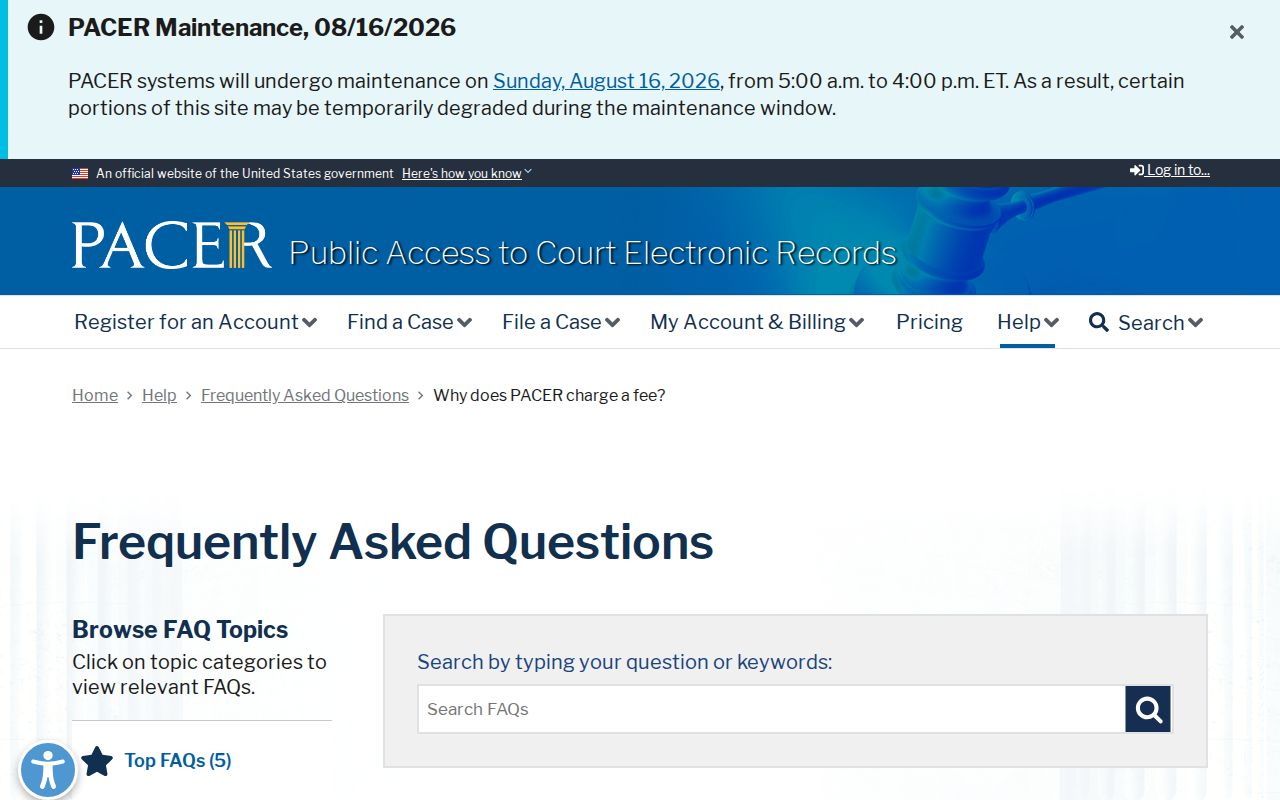
That fee schedule confirms where PACER ends. It serves only federal Cuba-related cases. A Cuba ticket, an ordinance matter, or a Sumter state case stays with its municipal or Alabama custodian.
How to Search the Cuba Court Docket
Cuba exposes no public database for searching. So skip the portal guessing and route by the citation instead. The court name and issuing body tell you whether a city custodian, the Sumter County Circuit Clerk, or another clerk holds the record. Work from the document, not from a search box.
- Copy the citation or case number exactly as printed.
- Identify the issuing agency and named court.
- Check the Alabama municipal-court directory for the current municipal arrangement.
- Contact the town or issuing court and ask for the date, status, and record-copy method.
- If the document names Sumter District Court, use the state traffic route or Circuit Clerk.
- Reconfirm the setting before travel or payment.
A blank online result proves nothing about the case. The Cuba matter may sit with a different court, be newly filed, restricted, or simply not shown in a public search. Absence online is not a closed file.
Cuba Court Records and Population Rank
Cuba ranks third among Sumter County municipalities in the 2020 Census, with 306 residents. That ranking explains which towns get city pages, nothing more. It says nothing about court caseload. No annual Cuba citation or disposition count exists to check it against.
The gap matters more than it seems. Population cannot be turned into an estimate of hearings or filings. If you need a local total, ask the current municipal custodian whether a public annual report exists. Ask what date range it covers, and whether it counts cases, charges, or settings. Those units do not swap cleanly.
The 2020 Census redistricting data is the official population source. The court record still has to come from the venue that issued it.
The Cuba Municipal Court
No official source confirms a Cuba municipal court page. Nor does it confirm a judge, clerk, hours, address, session day, or payment system. It would be wrong to describe a working court from that silence. Check the AOC municipal directory and the town's current contact route whenever a citation names a Cuba municipal venue.
There is another possibility. Cuba may run no municipal court. In that case, Alabama law lets ordinance matters be tried in District Court. Confirm that at the time of your inquiry. It is not proof the town court closed, or that every local citation already belongs to the county.
Ask one question first: which clerk has the cited matter today? That answer tells you where the Cuba docket lives and where to request a copy.
The Cuba Citation Controls Custody
A citation does more than state a charge. It names the court, the issuing agency, the case or citation number, the appearance date, and a payment or contact route. Those clues keep you from paying to search the wrong database.
| Working field | Why it matters | Who confirms it |
|---|---|---|
| Citation or case number | Distinguishes the exact Cuba matter | Issuing court |
| Issuing agency | Helps trace the original venue | Agency or clerk |
| Named court | Separates municipal from District custody | Court directory or clerk |
| Violation and scheduled dates | Frames the record and current setting | Newest notice or clerk |
| Copy type | Separates an informal status from a certified record | Actual custodian |
No Cuba portal spells out which fields are mandatory, so the custodian may ask for different details.
Cuba Court Dates and Settings
Cuba publishes no public calendar. Your date must come from the citation, a later notice, or straight from the issuing court. Never borrow Livingston's monthly schedule, and never assume a state payment screen shows every local setting.
| Date | The newest date from the Cuba or District case source. |
|---|---|
| Time | The specific appearance time confirmed by the custodian. |
| Location | The venue stated on the notice; no Cuba court address was verified. |
| Court | Municipal venue if maintained, or Sumter District Court when named. |
| Setting Type | Plea, trial, review, or other event stated by the court. |
A continuance or reset moves a setting. It does not dismiss the case. Read the later docket entries before trusting an old date.
Cuba Docket Directory Check
When a local court page is missing, the AOC municipal directory is the safest state-level check. Use it to verify whether the court is listed. Use it also to find the current official route. Remember the limits: a directory entry is not the Cuba docket itself. A missing online profile is not a legal finding that no municipal court exists.
Once you know the custodian, request the public case record by citation number. Name the items you need, such as the current setting, violation, plea, disposition, or costs. For a certified copy, ask that office for its own procedure and fee. Do not borrow the Circuit Clerk's schedule.
Key point: The directory resolves court identity. The issuing clerk resolves the actual Cuba case and its current setting.
Cuba Traffic Tickets
Start with the ticket itself. A Cuba municipal citation belongs to the venue named on it. Follow that court's instructions. A state ticket routed to Sumter District Court instead follows the county process. Payment options run through the Alabama Traffic Service Center, Alapay, phone help at (866) 954-9399, card payment by phone at (877) 252-7294, or mail to P.O. Box 936 in Livingston. The clerk can confirm directly, too.
Those state channels may not cover a Cuba city ticket at all. Confirm eligibility before you pay, and understand what payment means for the case. Paying a traffic ticket counts as a guilty plea. To fight it, follow the appearance instructions printed on the citation. Cuba offers no universal online not-guilty form or defensive-driving program. No local fee is set anywhere on the ticket materials.
If a state case is already past its deadline, call the clerk before touching a payment screen. A transaction alone will not fix the real status.
Cuba Court Docket or District TR
Alabama uses short court codes to route cases. The code TR marks a state traffic case in District Court. You may also see DV for District Criminal. CC stands for Circuit Criminal, and CV for Circuit Civil. Sumter County publishes no full code manual. So treat these letters as routing clues for a Cuba court docket, not a complete decoder.
AlaCourt ACCESS says it covers State Traffic Records. It does not promise every municipal citation. A Cuba citation with a District Court name may pull up a paid Case Action Summary there. So may a TR case number. A citation naming a city venue belongs with that municipal clerk instead.
That distinction keeps a Cuba docket search from turning into a county-wide paid name search.
Where Cuba Cases End Up
Case level decides the docket. Under Alabama Criminal Rule 30.1, a municipal criminal judgment can move to Sumter Circuit Court for trial de novo. A District state traffic judgment can take the permitted Circuit appeal route too. Felonies land in Circuit Court after preliminary proceedings.
Docket flow: Cuba issuing Municipal Court › Sumter County Courts › Circuit Court
Rule 30.1 gives you 14 days to appeal a Municipal or District criminal judgment. For a real appeal, follow current court rules and get legal advice. Once Circuit opens a case, call the Sumter County Circuit Clerk or run the new case number through AlaCourt.
Cuba County Records Route to Livingston
The Sumter County courthouse sits in Livingston, but that does not make the Circuit Clerk the keeper of Cuba municipal citations. The clerk holds Circuit and District records. A city matter stays with the municipal or issuing clerk until an appeal or county filing creates a new record.
Need a county case? Call the Circuit Clerk at (205) 652-2291. The courthouse address is 115 Franklin Street, with mail to P.O. Box 936. Rule 33 protects inspection and paid printed copies at circuit-clerk offices. AlaCourt ACCESS is the paid statewide web option.
The wider Sumter County court docket walks through those county channels. Try them only once a Cuba document points to Circuit or District Court.
Requesting a Cuba Court Record
Name the record, not just the person. A strong request for a Cuba court record gives the citation or case number. Add the issuing body and court, the violation date, and the scheduled date. Say whether a plain or certified copy is wanted. Ask the clerk to state the lawful fee. Ask about accepted payment and delivery method before anything is sent.
Cuba posts no public request form, hours, phone number, fee table, or turnaround time. So do not mail money to a guessed office. Do not promise yourself a fixed response time. Verify the current clerk first through the municipal directory or the issuing agency.
One caution: a docket or status summary is not the filed document. If you need a signed order or judgment, request that item by name. Certification must come from the clerk of record, not from a saved browser screen.
Public Access to Cuba Court Records
Alabama recognizes a right of access to public writings. Yet court-specific privacy rules still control confidential case material. A Cuba clerk can release a public municipal record. The clerk may still withhold juvenile, adoption, grand-jury, privileged, diversion, sealed, or protected personal information. A search that returns nothing does not prove a case was sealed. And a public case caption does not make every filing inside it public.
For Circuit and District court records, the chain of access runs through courthouse inspection, phone, mail, paid AlaCourt access, and a focused copy request. A Cuba municipal file is different; go through the verified municipal custodian instead.
Key Rules:
Alabama Code Sections 36-12-40 through 36-12-47 provide the public-writings framework subject to lawful exceptions.
Alabama Rule of Judicial Administration 33 preserves inspection and paid printed-copy access at circuit-clerk offices.
Court-Record Privacy Rule 201 lists confidential materials that are unavailable through an ordinary request.
Cuba Docket Fields Must Stay Verified
Cuba offers no case portal. So a Cuba docket search should not promise fields nobody can see. A Cuba clerk may ask for a citation number, issuing agency, name, violation date, or scheduled date. The exact required set depends on the custodian. Keeping a request to those basics avoids sharing more data than the clerk needs.
No official Cuba source lists a result grid, refresh schedule, document-image button, payment status, or export control. Ask the Cuba custodian directly what the case record contains. If a Cuba-related matter is filed as a Sumter District TR case, AlaCourt may show a Case Action Summary. But that county product is not a Cuba municipal portal.
A narrow Cuba request still works well. State the exact record you want, whether the newest setting, the disposition, a signed order, or a certified copy. Ask which Cuba or county office holds it. Ask the fee and how it can be delivered. Verified facts beat invented interface detail every time.